
Country Community Series #3: Social Cohesion - the ties that bind
In country towns like ours, community doesn’t just happen by accident. It’s built. Over cups of coffee, across fences, at the footy, in the main street, and through the quiet, everyday acts of looking out for one another.
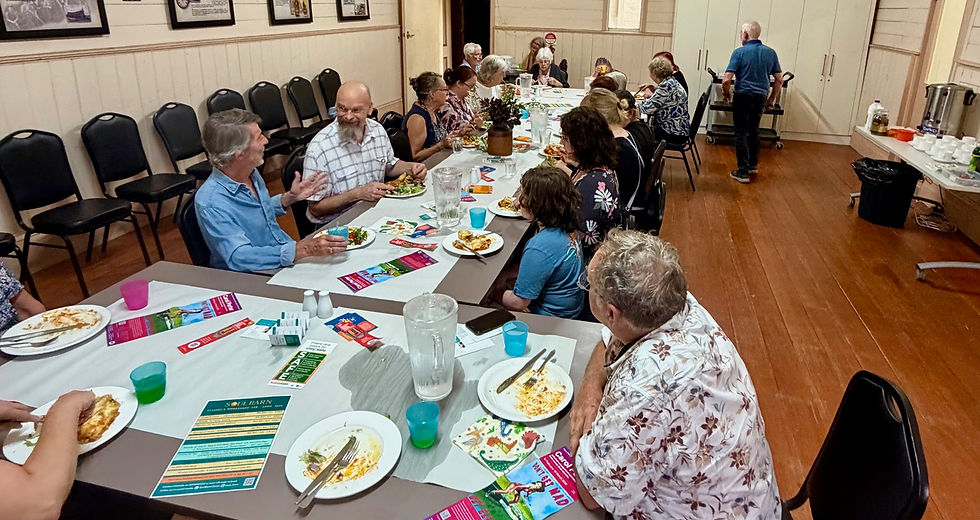
NEW Residents' Table, every third Tuesday at 6pm - 7.30pm at the Town Hall
Researchers often talk about social cohesion in terms of three kinds of assets: the “bonds” within close-knit groups, the “bridges” between different groups, and the “links” that connect people to institutions and decision-makers. Typically these assets fall into five types:
1. Social and Community Assets
Trust and Relationships: High levels of interpersonal and social trust, fostering a sense of mutual obligation and shared destiny.
Active Community Networks: Strong, inclusive networks, including local community groups, volunteering, and neighbourhood watch programs.
Shared Identity and Belonging: Fostering a sense of pride in the community, shared values, and a welcoming, inclusive environment for all.
Intercultural Understanding: Education, awareness-raising, and programs that promote respect for different cultures and perspectives.
2. Physical and Spatial Assets or what we refer to as the Built Environment
Accessible Public Spaces: Well-maintained, safe, and welcoming spaces (parks, community facilities, libraries) that encourage spontaneous interaction and "stickiness" (where people want to linger and chat).
Pedestrian-Friendly Infrastructure: Walkable neighbourhoods, good street lighting, and public transport that reduce isolation and foster casual social connections.
Shared Infrastructure: Community gardens, common workspaces (like the Men’s Shed, the Warehouse, Footy/Netball Club, the Pool or 25 Fraser Street), and community land trusts that facilitate collaboration and shared ownership.
3. Institutional and Governance Assets
Trust in Institutions: Confidence in police, health systems, and local, state, and national governments.
Inclusive Decision-Making: Opportunities for civic participation, such as participatory budgeting and community consultation processes, ensuring diverse voices are heard (the new Residents’ Table is an example of that at a very local level)
Equitable Resource Distribution: Policies that minimise social exclusion, address income inequality, and provide access to quality education, housing, and employment (like the Shared Users Policy at 25 Fraser)
Effective Public Services: Accessible and fair provision of services that meet the specific needs of the community.
4. Cultural and Social Capital
Active Citizenship: High levels of volunteering and participation in community arts, sports, and cultural events.
Shared Rituals and Memory: Use of shared history such as the Clunes Museum, public art, and cultural events like the Booktown Festival, Historical Truck Show or Clunes Agricultural Society Show to create a sense of community identity.
Strong Communication Channels: Inclusive language and communication strategies that bridge divides rather than creating them, like our noticeboards and Clunes Community Newsletter.
5. Economic Assets
Fair Employment and Economic Security: Opportunities for upward mobility, fair pay, and reduced economic disparity.
Affordable Housing: Stable housing and reduced residential mobility in neighborhoods to promote, rather than hinder, the formation of local ties.
Not all of these can be influenced (solely) by communities, some reflect our local context or involve bigger players. But you’d be surprised by how many social cohesion assets Clunes has readily available, and the impact they have. Here are just a few:
Community newsletter | Bridging Capital | Written by community, aims to reach everyone, free for groups to feature in, place for businesses to promote, place for stories by local people for local people (social and cultural capital) |
Town website – www.clunesvic.org.au | Bridging Capital | Website where businesses and groups can feature activities or information to showcase what the town has to offer |
Community notice boards (at Neighbourhood House, at 25 Fraser Street, near library) | Bonding/Bridging Capital | Inviting people to get involved or sharing news |
Online Noticeboards | Bonding/Bridging Capital | Inviting people to get involved or sharing news |
Signage about events | Bonding/Bridging Capital | Inviting people to get involved or sharing news |
Community notice boards (at Neighbourhood House, at 25 Fraser Street, near library) | Bonding/Bridging Capital | Inviting people to get involved or sharing news |
Community led facilities ie Footy/Netball Club ie 25 Fraser Street | Linking Capital | Builds working relationships between groups and institutions, like Council. These spaces often have a focus on sharing and working together, which nurtures cohesion. |
Community use of facilities like the Town Hall ie Dancin’ Clunes ie Residents Table meals ie Booktown Festival ie Private events like weddings and funerals | Bridging/Linking Capital | Builds a sense of belonging and shared ownership of space, helps people mark big occasions in places they feel at home |
Can you think of other, less conventional, examples of social cohesion assets in Clunes?
We can. Happy Hour at The National Hotel is a brilliant example of bridging and linking capital. Did you know that each week the proceeds from their raffle are donated to different groups in town who approach the pub when they have a need. Such a simple, fun and very ‘Country’ way that a business boosts social cohesion in our town and then uses the proceeds from that to help community.
These assets are not just static resources but rather "relational ties" that require ongoing, active nurturing and investment from individuals, communities, and all levels of government. In our next issue we’ll start to explore that more and share some of the stories of local social cohesion in action.
Why are we doing this? Because Clunes is an active community with many great social and shared assets. When the next challenge comes communities with strong social cohesion don’t just survive. They stand together, adapt together, and move forward stronger than before. And that's a great future to work towards.


Comments